Court finds former air force officers guilty in Taiwan’s latest espionage case*
A court in Taipei has found two former high-ranking military officers guilty of violating the national security law in the latest espionage case involving Taiwanese military personnel.
Former Air Force Major Gen. Chien Yao-tung and Lt. Col. Wei Hsien-yi were accused of trying to recruit active and retired officers to spy for China, the official Central News Agency (CNA) reported.
According to Tuesday’s court indictment, Chien and Wei approached at least five senior officers, both retired and on duty, on behalf of a Hong Kong businessman who acted as a recruiter for China’s state security ministry.
Among the officers introduced by the two to the Hong Kong man was Chang Che-ping, who served as Taiwan’s vice minister of defense in charge of policy from 2019-2021.
Chang was investigated in 2021 for his alleged contact with a Chinese spy ring but was not found guilty and officially named as a witness.
The two former officers – Chien and Wei – both received suspended sentences up to five years and were ordered to pay fines of up to TW$600,000 (U.S.$19,700), a punishment seen by some observers as too lenient.
“Taiwan"s military prosecutors have been abolished, so even if the accused were found guilty of participating in military espionage operations, the sentences could be brief and not making the necessary deterrent effect,” said Shen Ming-shih, acting deputy chief executive officer at the Institute for National Defense and Security Research in Taipei.
Taiwan’s Military Trial Act was amended in 2013 to eliminate military trials of officers in peacetime.
“Because of this, the problem of keeping secrets and preventing espionage in the military is becoming more and more serious,” Shen told RFA.
![]()
Kinmen’s colonel Hsiang Te-en (right) was accused of pledging allegiance to China in Jan. 2020. Credit: CNA
String of cases
Tuesday"s sentence in Taipei followed the arrest of seven members of an alleged spy ring led by a retired Air Force colonel in the southern city of Kaohsiung on Jan. 6.
The retired colonel, known as Liu, was accused of running espionage activities for at least eight years and was under surveillance, CNA reported.
The other six detainees were reportedly recruited by Liu from both the Taiwan Navy and Air Force. Three of them are active-duty officers.
On the same day as the arrest, a former legislator and a retired rear admiral of Taiwan’s navy were also questioned over their alleged involvement in the ring led by Liu.
Lo Chih-ming and Hsia Fu-hsiang both denied they helped recruit retired military personnel for the spy ring and were released on bail.
“Judging from these cases, China"s infiltration of Taiwan"s military has become very serious and there may be more cases that have not been exposed,” said INDSR’s Shen Ming-shih.
The espionage, besides stealing military secrets, also “threatens the internal psychological defense” of serving personnel, Shen said.
In November 2022, Taiwanese local media reported two other cases of espionage involving military officers.
A retired major in Taiwan’s Marines was arrested after entering the Zuoying Navy Base in Kaohsiung with a forged ID on Nov. 17.
A few days later, an army colonel on the frontline island of Kinmen was discovered to be working for China. The colonel, who held several important positions until his suspension last year, pledged allegiance to China and even promised, on the record, to surrender in the event of a Chinese attack.
The investigation into these two cases continues.
A Reuters review of court records and Taiwan’s official media reports in 2021 found that at least 21 current and former officers with the rank of captain or above have been convicted of spying for China over the past decade.
“Taiwan’s military should strengthen education to help officers and soldiers recognize China’s true intentions,” said Shen Ming-shih.
“The military also needs to strengthen the assessment of senior officers’ promotions, conduct regular loyalty tests for promotions of generals, and amend the law to severely punish espionage crimes,” the analyst said.
In the case of conflict, “intensive orders should be used to control the activities of pro-China political parties and civilians, so that they do not become obstacles in combat,” Shen suggested.
 | 喜歡這篇嗎?快分享吧! |
前一頁
後一頁









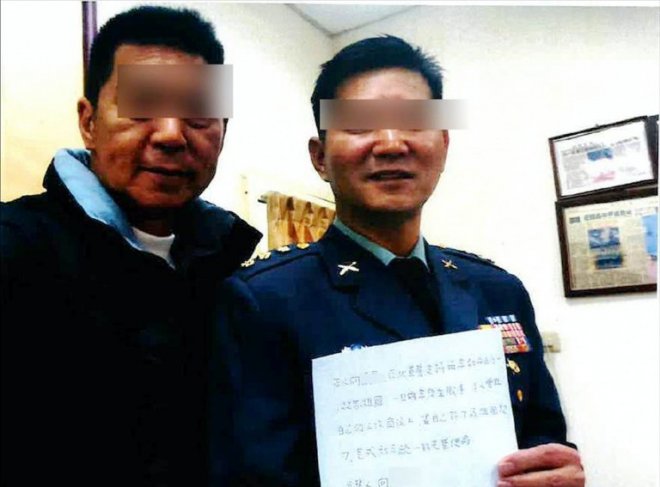 Kinmen’s colonel Hsiang Te-en (right) was accused of pledging allegiance to China in Jan. 2020. Credit: CNA