Palestinian leader supports China’s Uyghur policies in joint statement*
During his visit this week to China, Palestinian President Mahmoud Abbas voiced support for China’s policies in the far western region of Xinjiang, where the United Nations has found credible patterns of torture and ill treatment against the mostly Muslim Uyghurs living there.
A joint statement issued shortly after Abbas met with Chinese President Xi Jinping on Wednesday declared that “Xinjiang-related issues are not human rights issues at all, but anti-violent terrorism, de-radicalization and anti-separatism.”
“Palestine firmly opposes interference in China"s internal affairs under the pretext of Xinjiang-related issues,” it read.
The statement also declared the Palestinian Authority’s support for China in regards to Taiwan and Hong Kong, recognizing Xi’s government as the “only legal government representing the whole of China.”
Abbas is on a four-day trip to discuss China’s potential role in peace talks between Israel and the Palestinians, who live in territories occupied by Israel, which has imposed many restrictions on the movement and activities of the mostly Muslim Palestinians.
Prioritizing national interests
Although Palestinians would have reasons to support the Uyghurs, siding with China benefits Palestinians’ national interests, said Erkin Ekrem, an associate professor of China foreign policy at Hacettepe University in Turkey.
The Palestinian Authority is becoming more dependent on China and is in need of Chinese funds, technology and support on the international stage, he said.
“The Uyghur issue does not align with Palestine"s interests,” Ekren said. “Therefore, the primary concern here is the national interest of Palestine.”
“The benefits they can gain from China outweigh the gains of supporting the Uyghurs,” said Ekrem. “In this kind of situation, the Uyghur issue, despite the fact that the Uyghurs are Muslims, is not a priority for them.”
![]()
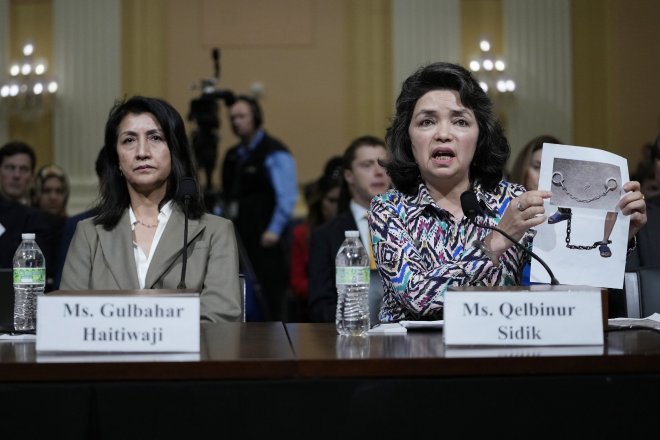
Qelbinur Sidik, a China"s ethnic Uzbek minority who was forced to teach Chinese in detention facilities for Uyghur detainees, right, joined by author Gulbahar Haitiwaji, who wrote a book about her experience of being held in “re-education “camps for more than two years, holds up images as she testifies during a special House committee hearing dedicated to countering China, in March 23, 2023, in Washington. In a comprehensive report released in August, the Office of the U.N. High Commissioner for Human Rights, found that China’s arbitrary detentions against Uyghur and other minorities in Xinjiang “may constitute international crimes, in particular crimes against humanity.” Credit: Carolyn Kaster/AP
Ekrem noted that previous Palestinian leaders, including Yasser Arafat, expressed support for China’s Uyghur policies.
The Abbas and Xi’s joint declaration comes amid a growing body of evidence documenting the detention of up to 1.8 million Uyghurs and others in “re-education” camps, torture, sexual abuse and forced labor.
In a comprehensive report released in August, the Office of the U.N. High Commissioner for Human Rights, found that China’s arbitrary detentions against Uyghur and other minorities in Xinjiang “may constitute international crimes, in particular crimes against humanity.”
Yet a number of Muslim-majority countries have not criticized China’s policies in the Xinjiang Uyghur Autonomous Region – or have openly supported them – so as not to alienate or upset Beijing, experts say.
Countering U.S. sway
China, meanwhile, has been drawing Arab countries closer to itself to counter U.S. influence in the Middle East, experts say.
Regarding Beijing’s role in brokering a peace deal between Israel and Palestine, China is trying to show itself to be a reliable partner in tackling regional issues, Giorgio Cafiero, CEO and founder of Washington-based Gulf State Analytics, told RFA.
“If the Chinese are able to make some progress on this issue, that would do a lot to send a message to regional actors about the benefits of working with Beijing instead of Washington when it comes to sensitive diplomatic files in the region,” said Cafiero.
He said that Palestine sees itself as disadvantaged in its conflicts with Israel and would trust China more than the United States – a strong supporter of Israel – as a facilitator in peace talks.
“I"m sure that viewers will be disappointed by this statement from Abbas, but the Palestinian leadership has to be pragmatic about how it engages with foreign governments,” he said.
“At the end of the day, China is very important to Abbas, and his priority, being on good terms with China and improving his relationship with Beijing, involves him saying things that many Uyghurs do not like.”
Translated by Mamatjan Juma. Edited by Eugene Whong and Malcolm Foster.
 | 喜歡這篇嗎?快分享吧! |
前一頁
後一頁










 Qelbinur Sidik, a China"s ethnic Uzbek minority who was forced to teach Chinese in detention facilities for Uyghur detainees, right, joined by author Gulbahar Haitiwaji, who wrote a book about her experience of being held in “re-education “camps for more than two years, holds up images as she testifies during a special House committee hearing dedicated to countering China, in March 23, 2023, in Washington. In a comprehensive report released in August, the Office of the U.N. High Commissioner for Human Rights, found that China’s arbitrary detentions against Uyghur and other minorities in Xinjiang “may constitute international crimes, in particular crimes against humanity.” Credit: Carolyn Kaster/AP